
The Bloody Mary cocktail, a beloved brunch staple and reputed hangover cure, boasts a history as rich and complex as its flavor profile. Like many legendary cocktails, its precise beginnings are shrouded in a fascinating blend of historical clues, personal claims, and clever marketing. While numerous individuals and establishments have laid claim to its creation, a closer examination reveals two primary contenders for the title of the Bloody Mary’s inventor. Join us as we meticulously explore the compelling narratives behind this iconic drink, unraveling the mysteries of its birth and evolution into the global phenomenon it is today.
Unraveling the Origins of the Bloody Mary: A Dual Narrative
The quest to pinpoint the definitive origin of the Bloody Mary cocktail invariably leads to two compelling, yet distinct, historical accounts. Both narratives present a mosaic of supporting evidence and intriguing questions. Our journey will delve into these two prominent stories, seeking to illuminate the most plausible path to the Bloody Mary as we know it.
Establishing the Historical Framework: Concrete Facts and Timelines
Understanding the true genesis of any cocktail requires sifting through historical records, which can often be imprecise or incomplete. In the early 20th century, the meticulous documentation of cocktail recipes and their creators was not a widespread practice. Nevertheless, certain undeniable facts provide a crucial timeline for the Bloody Mary’s development. These foundational points offer a structured framework against which to evaluate the various claims:
- 1934: The Red Snapper Emerges at St. Regis King Cole Bar. A cocktail remarkably similar to a Bloody Mary, known as the Red Snapper, began to be served at the prestigious St. Regis King Cole Bar. This particular drink features prominently in one of the leading origin stories and uses gin instead of vodka.
- 1939-1940: Early Mentions in Print. Several influential publications began featuring articles that directly named the “Bloody Mary” cocktail. These early recipes, while not entirely matching today’s widely recognized formulation, consistently included both vodka and tomato juice. Notable mentions appeared in The Voice of Broadway magazine in New York, the Chicago Tribune, and the New York Herald. These instances mark the first recorded public acknowledgments of the drink by name.
- 1941: The Red Snapper Recipe Published. Crosby Gaige’s Cocktail Guide and Ladies Companion presented what is considered the first printed recipe closely resembling a modern Bloody Mary. However, it was explicitly named “Red Snapper” and called for gin as its base spirit, underscoring the early prominence of this gin-based variant.
- 1946: The First Named Bloody Mary Recipe. The definitive moment for the printed Bloody Mary arrived with Lucius Beebe’s Stork Club Bar Book. This publication contained the first official recipe explicitly titled “Bloody Mary,” solidifying its name and general ingredients in the public consciousness.
Considering these critical dates, it becomes highly improbable for any origin story to credibly predate 1939 for the named cocktail, and any claims extending beyond 1946 for the complete, published recipe are firmly ruled out by these established facts.
Fernand Petiot: The Parisian Pioneer and the Birth of the Bloody Mary, Part 1
One of the most widely cited origin stories traces the Bloody Mary back to post-World War I Paris, attributing its creation to a talented bartender named Fernand “Pete” Petiot. Petiot himself claimed to have invented the cocktail as early as 1921. While concrete, explicit documentation from that exact period proving his claim is scarce, compelling historical clues lend significant validity to his narrative.
Harry’s New York Bar: A Cradle of Cocktail Innovation
Petiot’s story is deeply intertwined with Harry’s New York Bar in Paris, an establishment that opened in the early 1900s. Fernand began his career there as a young kitchen hand, meticulously working his way up the ranks to become a respected bartender. It was within the vibrant atmosphere of Harry’s Bar, a renowned haunt for American expatriates like Ernest Hemingway and Sinclair Lewis, that Petiot claimed to have mixed the first Bloody Mary. Harry’s Bar is also credited with the invention of other classic cocktails, such as the Sidecar cocktail, reinforcing its reputation as a hub of mixological creativity.
According to a 1970s article in The Cleveland Press, the cocktail received its distinctive name not directly from a person within the bar, but as an homage to another establishment and a server. The theory posits that the drink was named after a Chicago bar called “Bucket of Blood” and a waitress known as “Bloody Mary” who worked there. Petiot reportedly recounted that his first two customers for the drink “were from Chicago, and they say there is a bar there named the Bucket of Blood. And there is a waitress there everybody calls Bloody Mary. One of the boys said that the drink reminds him of Bloody Mary, and the name stuck.” This anecdote paints a vivid picture of the cocktail’s early naming, linking it to American cultural references even in a Parisian setting.
From Paris to New York: The Red Snapper’s Debut
Following the repeal of Prohibition in the United States, Petiot immigrated to America, eventually securing a prominent position as a bartender at the elite St. Regis King Cole Bar in New York City around 1933-1934. It was here that he introduced a variant of his creation: the Red Snapper cocktail. Crucially, the Red Snapper is essentially a Bloody Mary, but with gin as its base spirit rather than vodka. This distinction leads to an important question regarding the original spirit choice.
The Enigma of Vodka: Why Gin for the Red Snapper?
The choice of gin for the Red Snapper in the U.S. context highlights a significant historical detail: vodka was largely an obscure and unused spirit in America prior to World War II. Its meteoric rise to popularity in the States occurred primarily after the war, largely due to successful marketing campaigns, notably Smirnoff’s promotion of the Moscow Mule. Before this era, vodka was a rarity, not widely available or consumed by the American mainstream.
Vodka’s Availability in Post-WWI Paris
While vodka’s presence in the U.S. was minimal, its accessibility in post-World War I Paris offers a plausible explanation for Petiot’s experimentation. Harry’s New York Bar, despite its American name, was situated in Europe. More significantly, Paris experienced a substantial influx of Russian immigrants following the Russian Revolution of 1917. This demographic shift would naturally have created a demand for Russian liquor, leading to increased availability and consumption of vodka in Parisian markets. This unique cultural confluence could have provided Petiot with both the opportunity and the incentive to incorporate vodka into his innovative cocktails.
Adding another layer to this theory, Harry’s New York Bar was also a known gathering place for Russian exiles, including notable figures like Serge Obelensky, who participated in the Russian Revolution. Incidentally, Obolensky later married into the illustrious Astor family, renowned for their hotel empire, which included the St. Regis Hotel in New York—the very establishment where Petiot would later work. This intricate network of connections further strengthens the argument for vodka’s presence and Petiot’s familiarity with it in his early Parisian years.
The Naming Convention: Bloody Mary vs. Red Snapper
It has been suggested that the “Bloody” moniker was deemed too uncouth for the sophisticated clientele of the St. Regis King Cole Bar, prompting Petiot to rename his gin-based creation the “Red Snapper.” However, concrete evidence supporting this specific reason for the name change remains elusive. Furthermore, consistent documentation of Petiot serving a drink specifically called “Bloody Mary” prior to the public printing of the recipe is difficult to find, leaving a gap in the early naming timeline.
The Core Ingredients: Petiot’s Definitive Signature
Despite some ambiguities regarding the exact name and initial spirit, one of the most compelling aspects connecting Petiot to the Bloody Mary’s origin is the comprehensive set of ingredients he employed. The Red Snapper, essentially a Bloody Mary with gin, features all the distinctive components that define the modern cocktail. Its complexity, incorporating spices and savory elements beyond just spirit and juice, distinguishes Petiot’s creation and firmly places him as a pioneer of its characteristic flavor profile.
Addressing the Tomato Juice Debate
A common argument against Petiot’s 1921 claim revolves around the mass production of canned tomato juice, which did not become widespread until the mid-1920s. Critics argue that if mass-produced tomato juice was unavailable, Petiot could not have created the Bloody Mary so early. However, this argument overlooks several factors. Tomato juice itself reportedly gained popularity as a beverage in the late 1910s, quickly becoming a fashionable health drink. Moreover, the 1930s and 1940s saw a surge in non-alcoholic tomato-based concoctions promoted for their health benefits. Therefore, while canned juice might have been less common, fresh tomato juice was certainly available, and the concept of a savory tomato drink was gaining traction, making Petiot’s use of it in 1921 entirely plausible.
In summation, Fernand Petiot’s claim presents a robust foundation for the Bloody Mary’s origin. The environment of Harry’s New York Bar, a melting pot of American and Russian cultures in Paris, provides a credible context for the introduction of vodka. His invention of the Red Snapper, a cocktail nearly identical to today’s Bloody Mary save for the base spirit, strongly links him to the drink’s complete formulation. The switch from vodka to gin in the U.S. is logically explained by vodka’s initial unpopularity.
However, lingering questions persist. The absence of documented “Bloody Mary” menus from the 1920s and early 1930s, and the somewhat limited availability of mass-produced tomato juice in early 1920s Paris, leave aspects of Petiot’s narrative open to further scrutiny. While fresh juice was an option, the widespread adoption of the cocktail would likely necessitate broader ingredient accessibility.
George Jessel: The Celebrity Claim and the Birth of the Bloody Mary, Part 2
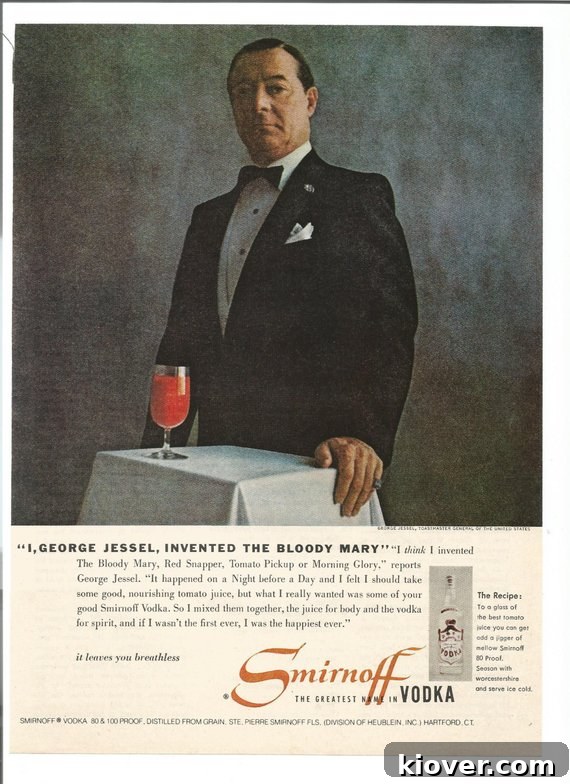
The second major claimant to the Bloody Mary’s invention is George Jessel, a prominent American comedian and socialite of the era. Jessel’s assertion gained significant public traction, particularly through a high-profile marketing campaign by Smirnoff in the 1950s, which boldly declared: “I, George Jessel, Invented the Bloody Mary.”
Smirnoff, a master of marketing, undoubtedly capitalized on Jessel’s celebrity status. Attaching a famous face to the cocktail’s origin provided an appealing narrative, potentially more for its promotional value than its absolute historical accuracy. Jessel’s claim, therefore, must be examined through the lens of both personal recollection and commercial endorsement.
George Jessel’s Account: A Hangover Cure and a Spilled Drink
Jessel provided a detailed account of the Bloody Mary’s creation in his 1975 autobiography, The World I Lived In. His narrative, colorful and theatrical, describes a fateful morning in 1927 in Palm Beach:
I have always had a great penchant for the sauce and have concocted many varieties of highballs and mixed drinks over the years. But very few people know how the Bloody Mary came to be. Today, it is one of the most popular “morning after” or “hangover” cures there is, as well as a companion for Sunday brunch.
In 1927, I was living in Palm Beach, or on a short visit, I don’t remember which, where nearly every year I captained a softball team for a game against the elite of Palm Beach such as the Woolworth Donohues, the Al Vanderbilts, the Reeves, and their ilk. My team was made up of rag-tag New York cafe society. Because I had been around Broadway and baseball characters, I managed to slip in a ringer now and again. (We generally won.)
On this particular trip I brought along Buddle Adler, a semi-pro on Long Island and a shoe salesman during the week. Buddy was later to become production head at 20th Century-Fox and marry Anita Louise. Both of them, unfortunately, are now dead. The proceeds of our, shall we say, friendly wagers on the games, went to a charity for underprivileged children. Adler hit a home run with the bases loaded, and we won the game and collected several thousand dollars in bets.
There was a famous hangout in Palm Beach at the time run by Paddy La Maze, a former ball player himself. To the winners, he let them drink all the champagne they could take; the losers, beer.
Following the game, Adler (who was hung like a bull, generally came along to try to find a rich dowager to marry but never did), myself, and a guy named Elliott Sperver, a Philadelphia playboy, went to La Maze’s and started swilling champagne. We were still going strong at 8:00 A.M. the next morning. I had a 9:30 volleyball date with Al Vanderbilt. I was feeling no pain at all.
We tried everything to kill our hangovers and sober up. Then Charlie, the bartender, enjoying our plight, reached behind the bar.
“Here, Georgie, try this,” he said, holding up a dusty bottle I had never seen before. “They call it _vodkee_. We’ve had it for six years and nobody has ever asked for it….”
I looked at it, sniffed it. It was pretty pungent and smelled like rotten potatoes. “Hell, what have we got to lose? Get me some Worcestershire sauce, some tomato juice, and lemon; that ought to kill the smell,” I commanded Charlie. I also remembered that Constance Talmadge, destined to be my future sister-in-law, always used to drink something with tomatoes in it to clear her head the next morning and it always worked–at least for her.
“We’ve tried everything else, boys, we might as well try this,” I said as I started mixing the ingredients in a large glass. After we had taken a few quaffs, we all started to feel a little better. The mixture seemed to knock out the butterflies.
Just at that moment, Mary Brown Warburton walked in. A member of the Philadelphia branch of the Wanamaker department store family, she liked to be around show business people and later had a fling with Ted Healey, the comic. She had obviously been out all night because she was still dressed in a beautiful white evening dress.
“Here, Mary, take a taste of this and see what you think of it.”
Just as she did, she spilled some down the front of her white evening gown, took one look at the mess, and laughed, “Now, you can call me Bloody Mary, George!”
From that day to this, the concoction I put together at La Maze’s has remained a Bloody Mary with very few variations. Charlie pushed it every morning when “the gang” was under the weather.
Now, about a year later, the benefit for Joe E. Lewis was to be held at the Oriental Theater and I was sitting in my hotel room with Ted Healey before leaving for the theater. Ted, as usual, was slightly inebriated. He happened to pick up a copy of a Chicago paper and read an item in Winchell’s column. It said that I had named the Bloody Mary after Ted’s then steady girl, Mary Brown Warburton.
Ted turned white. “What the hell are you doing making a pass at my girl, you son of a bitch,” he yelled. And just as he did, he pulled out a pistol and tried to shoot me. I ducked and the shot missed, but as the pistol went off within a foot of my right ear, I was completely deaf for a week. I had a hell of a job doing the benefit that night.
But at least now you know the origin of the Bloody Mary, and I believe it was _Esquire_ magazine who finally gave me credit for it many, many years ago.
Too bad I can’t collect royalties on it. In fact, I have never even received a case of vodka from any of the distillers for helping to make vodka the most popular, er, beverage in the United States today.
Jessel’s story suggests the Bloody Mary was born out of serendipity – a spontaneous concoction to cure a hangover, inadvertently named after a socialite who spilled the drink on herself. His celebrity status undoubtedly amplified the reach of this narrative, leading to its widespread recognition in the press.
Strengths Supporting George Jessel’s Claim
The 1939 Winchell Article: A Celebrity Connection
A significant piece of evidence for Jessel’s claim is an article published in the Chicago Tribune in 1939 by renowned celebrity gossip columnist Walter Winchell. Winchell, a childhood friend and former vaudeville partner of Jessel, wrote about the Bloody Mary. This close personal connection suggests that Jessel’s involvement in the drink’s genesis was not merely a random association, providing an early, albeit indirect, endorsement of his claim.
The 1940 Beebe Article: Explicit Credit
Further bolstering Jessel’s case is a 1940 article by New York Herald columnist Lucius Beebe, which explicitly attributed the creation of the Bloody Mary to Jessel. Beebe’s piece read: “George Jessel’s newest pick-me-up which is receiving attention from the town’s paragraphers is called a Bloody Mary: half tomato juice, half vodka.” This direct attribution from a respected columnist provides strong early documentation of Jessel’s connection to the drink.
Mary Brown Warburton: A Real-Life Inspiration
Unlike some legendary figures in cocktail folklore, the woman central to Jessel’s naming story, Mary Brown Warburton, was a verifiable historical figure. Photographs and records confirm her existence. She was the daughter of Barclay Harding Warburton, a prominent Philadelphian who served as mayor of Palm Beach in 1928. Her socialite status and family background place her squarely within the circles Jessel describes in his autobiography, making her presence at such a gathering entirely plausible. This factual basis for the namesake significantly strengthens the credibility of Jessel’s account of how the drink acquired its memorable name.
Smirnoff’s Endorsement: Weighing the Commercial Impact
The explicit credit given to Jessel by Smirnoff, a leading vodka distiller, in their 1950s advertising campaigns, carries considerable weight. While one could argue that a celebrity spokesperson simplifies marketing, Smirnoff’s authoritative position in the vodka industry lends a certain gravitas to their association with Jessel’s story. This commercial endorsement played a crucial role in popularizing both Jessel’s claim and the Bloody Mary itself.
Holes and Inconsistencies in George Jessel’s Narrative
The “Two-Ingredient” Bloody Mary: A Critical Omission?
Perhaps the most significant weakness in Jessel’s origin story lies in the early descriptions of his “Bloody Mary.” Both the influential Winchell and Beebe articles, while attributing the drink to Jessel, consistently describe it as a simple mixture of “half tomato juice, half vodka.” This two-ingredient formulation starkly contrasts with the complex, spiced version that defines the modern Bloody Mary and Petiot’s Red Snapper.
Fernand Petiot himself addressed this disparity in a 1964 New Yorker article, stating: “I initiated the Bloody Mary of today. George Jessel said he created it, but it really was nothing but vodka and tomato juice when I took it over.” While Jessel’s 1975 autobiography does include ingredients like Worcestershire sauce and lemon, this later account may be a retroactive addition, incorporating the evolved recipe rather than reflecting his original, simpler concoction.
Furthermore, the 1955 Smirnoff campaign, while crediting Jessel with the Bloody Mary, also erroneously attributed the Red Snapper to him, further muddying the waters and raising questions about the accuracy of all claims made within promotional materials.
La Maze’s: Speakeasy or Phantom Establishment?
Jessel’s 1975 account places the Bloody Mary’s creation at a “famous hangout” in Palm Beach called La Maze’s. Curiously, historical records for a public restaurant or bar by that name in Palm Beach during 1927 are difficult to find. Given that 1927 was deep within the Prohibition era, any establishment serving “lots of booze,” as Jessel implies, would almost certainly have been a speakeasy or a private residence operating discreetly. Jessel himself refers to it as a “hangout run by a former ball player,” rather than a formal establishment. This suggests a less public, perhaps more informal setting, which complicates the historical verification of the specific location and the cocktail’s public introduction.
Factual Discrepancies in Jessel’s 1975 Timeline
Close scrutiny of Jessel’s 1975 autobiography reveals notable inconsistencies in his timeline following the alleged 1927 creation. He mentions a benefit for comedian Joe E. Lewis, who was brutally beaten in 1927. This part is historically accurate. However, Jessel then describes sitting with Ted Healy (who later created The Three Stooges) and reading a Winchell column in a Chicago paper that attributed the Bloody Mary’s naming to Mary Brown Warburton. The critical flaw here is that the first known Winchell article mentioning the Bloody Mary did not appear until 1939. By 1939, both Ted Healy and Mary Brown Warburton were deceased. This significant temporal mismatch casts serious doubt on the precise details and sequence of events as recounted in Jessel’s later autobiography, suggesting a blurring of memory or creative embellishment over time.
The Smirnoff Ad vs. Autobiography: Shifting Certainty
A comparison between the assertive tone of Jessel’s 1975 autobiography and his earlier statement in the 1955 Smirnoff ad, where he famously said, “I think I invented The Bloody Mary,” reveals a subtle but important shift in certainty. The hesitation implied by “I think” in the earlier advertisement contrasts sharply with the confident, detailed account presented two decades later. While this doesn’t outright disprove his involvement, it raises questions about the clarity of his recollection at different points in time, suggesting that the narrative may have solidified and become more elaborate over the years.
Other Notable Claims to the Bloody Mary’s Genesis
Beyond the two main contenders, a few other individuals and narratives have surfaced regarding the Bloody Mary’s origins, each adding a layer of intrigue to its complex history.
Henry Zbikiewicz and the 21 Club
One of the earliest publications mentioning the Bloody Mary attributed the drink to the prestigious 21 Club in New York City. At that time, Henry Zbikiewicz was the bartender reportedly responsible for mixing these cocktails. Interestingly, many figures associated with the Bloody Mary narrative had connections to the 21 Club. George Jessel was a regular patron, and both Walter Winchell (who credited Jessel in 1939) and Lucius Beebe (who did the same in 1940) had ties to the establishment. While Zbikiewicz could plausibly have prepared an early version of the drink in the 1930s, it’s more likely that Jessel, with his social connections, introduced the two-ingredient vodka-and-tomato-juice concoction to the 21 Club, which Zbikiewicz then served.
Prince Serge Obolensky: The Spicy Twist
Returning to the Petiot narrative, Prince Serge Obolensky, a Russian exile and regular at Harry’s New York Bar, later became connected to Petiot’s future employer, the St. Regis. A popular anecdote suggests that Obolensky, upon ordering a tomato juice cocktail (possibly Petiot’s early Bloody Mary or Red Snapper), requested that it be “spiced up.” This request is often cited as the moment when ingredients like lemon, Worcestershire sauce, and Tabasco were added to the Bloody Mary’s evolving recipe. While Obolensky’s interaction with Petiot might have influenced the drink’s development, it’s generally accepted that the core creation remains Petiot’s, with Obolensky perhaps inspiring a refinement rather than an invention.
Queen Mary I of England: The Macabre Moniker
The most ancient, and perhaps most unlikely, namesake candidate is Queen Mary I of England, famously known as “Bloody Mary” for her persecution of Protestants during her brief reign. While her grim nickname is historically accurate, there is no credible historical evidence to suggest any direct link between the 16th-century monarch and the 20th-century cocktail. The other origin stories provide specific, contextual explanations for the drink’s name, which hold far greater weight than any speculative connection to the Tudor queen.
My Concluding Perspective on the Bloody Mary’s True Origin
After navigating through a wealth of historical accounts, personal anecdotes, and intricate timelines, my conclusion points toward an unwitting, yet essential, collaboration between Fernand Petiot and George Jessel in the birth of the Bloody Mary as we know it today. I firmly believe that Petiot, operating within the cosmopolitan environment of Harry’s New York Bar in 1920s Paris, possessed both the opportunity and the means to create a sophisticated, spiced tomato and vodka drink. His subsequent introduction of the Red Snapper in the United States, utilizing gin, was a logical adaptation to the prevailing American palate, where vodka had yet to gain widespread popularity.
Simultaneously, I credit George Jessel with independently developing a simpler vodka-and-tomato-juice mixture in the late 1920s, perhaps as the “hangover cure” he vividly describes. More crucially, I believe Jessel’s account of how the drink acquired its memorable “Bloody Mary” name holds true. His celebrity status and extensive social connections were instrumental in popularizing this catchy moniker and introducing the basic concept of a vodka and tomato juice cocktail to a broader American audience.
Petiot’s Red Snapper undoubtedly represented a groundbreaking advancement in cocktail mixology, showcasing a full spectrum of savory flavors. As vodka’s appeal surged in the 1940s and 1950s, thanks in part to marketing efforts, it was only natural for the original vodka component of what I consider Petiot’s conception to return to prominence. The influential Smirnoff advertising campaigns of the 1950s, which frequently mentioned the drink (as evidenced by its increasing appearance in publications), cemented both the Bloody Mary’s place in cocktail culture and, significantly, George Jessel’s association with its name.
Therefore, it is the remarkable confluence of Petiot’s innovative, ingredient-rich formulation and Jessel’s celebrity-driven naming and early popularization (spurred by a convivial, hangover-induced moment) that has shaped the Bloody Mary into the enduring classic it is today. Neither figure alone can lay sole claim to its complete genesis; rather, their distinct contributions converged to create this beloved cocktail. This collaborative origin story underscores the vibrant and often unpredictable evolution of cocktail culture.