
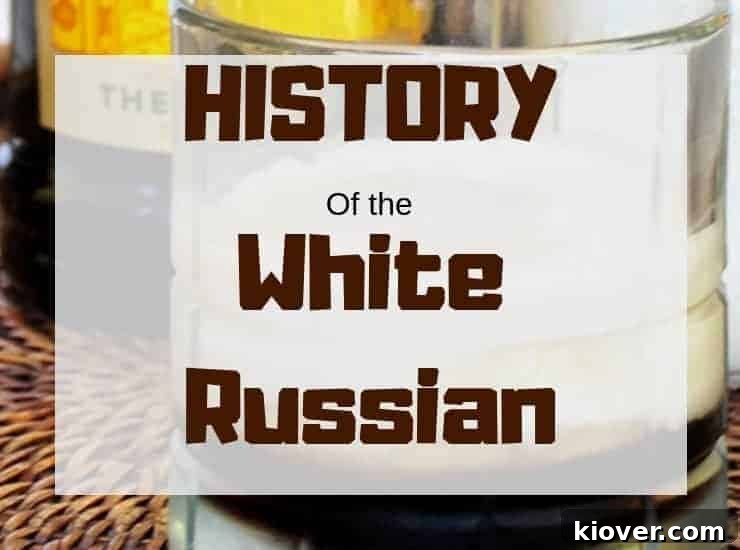
The world of food and cocktail history is a fascinating tapestry, often revealing the intricate threads of our global connectivity. The White Russian cocktail, a seemingly simple concoction, is a prime example of this interconnectedness. Far from being conceived in a frosty Siberian retreat as its name might suggest, the true story of this creamy classic is a vibrant journey spanning continents and cultures. It’s a narrative that takes us from the ancient coffee fields of Ethiopia to the sun-drenched sugarcane plantations of Mexico, and ultimately to the sophisticated bars of Brussels. And while Russia certainly plays a part through its iconic spirit, vodka, its role is perhaps less direct than many might assume. Join us as we delve deep into the captivating history of the White Russian cocktail, exploring the global influences that shaped this beloved drink.
The Genesis Moment: Pinpointing the White Russian’s “Big Bang”
While the White Russian feels like an timeless fixture in the cocktail canon, its formal documented debut is surprisingly recent. To truly understand its evolution, we must first identify the moment it officially entered the public consciousness. While it was undoubtedly enjoyed in various forms before its official publication, the earliest known printed reference to the White Russian cocktail appeared in 1965. This significant mention was found in the Oakland Tribune, marking what many cocktail historians consider its formal “big bang.” While the exact article remains elusive for many researchers (if you happen to stumble upon it, do share!), most authoritative sources cite this as the first official acknowledgment of the cocktail by its now-famous name.
This 1965 appearance solidifies its place in cocktail history, but it’s crucial to remember that cocktails often exist informally long before they are codified in print. The White Russian likely enjoyed a period of quiet popularity in bars and homes before its official media debut. Yet, this printed record served as a critical turning point, propelling the drink into wider recognition. However, to truly appreciate the White Russian, one must look further back, understanding the confluence of ingredients and inspirations that paved its way to that fateful Oakland Tribune article.
The Elder Sibling: Understanding the Black Russian Connection
It is impossible to discuss the White Russian cocktail without first acknowledging its direct predecessor, the Black Russian. Indeed, the Black Russian is the original, the older sibling that laid the foundation for the creamy variant we know and love. The creation of the Black Russian is far more definitively documented than its white counterpart. It came into existence in 1949 in the elegant setting of Brussels, Belgium. The master behind this initial creation was Gustove Tops, a skilled bartender working at the prestigious Hotel Metropole bar. Tops crafted the drink as a special tribute to the then US Ambassador to Luxembourg, Perle Mesta. Mesta was not only a prominent diplomat but also a renowned socialite whose vibrant personality and legendary parties even inspired a Broadway play, later adapted for the silver screen. The Black Russian, a simple yet potent mix of vodka and coffee liqueur, quickly gained traction, securing its place on menus and beginning its global journey, setting the stage for the White Russian’s eventual emergence with the simple addition of cream.
Vodka’s American Ascent: From Obscurity to Cocktail Stardom
The story of the White Russian, and indeed many iconic cocktails of the mid-20th century, is inextricably linked to the meteoric rise of vodka. As I’ve explored in the history of the Moscow Mule and the Greyhound, vodka’s journey to popularity in America was a long and arduous one. Prior to World War II, vodka was largely an unknown or unpopular spirit in the United States and much of Western Europe. It simply wasn’t part of the established drinking culture, which favored whiskies, gin, and brandy.
However, this all began to change dramatically in the post-war era, largely thanks to the innovative marketing efforts of Rudolph Kunett, the owner of Smirnoff Vodka in America. Kunett faced the monumental task of introducing a seemingly alien spirit to American palates. His genius lay in positioning vodka not as a replacement for traditional spirits, but as a versatile, “invisible” base for new and exciting cocktails. Campaigns like “It leaves you breathless” and the widespread promotion of the Moscow Mule (vodka, ginger beer, lime) and the Greyhound (vodka, grapefruit juice) fundamentally shifted perceptions. Vodka, once a tough sell, was reinvented as the ideal, neutral spirit that could blend seamlessly into almost any mixer, allowing other flavors to shine. This strategic pivot transformed vodka from an obscure Eastern European drink into a staple of the American bar scene, making possible the very existence and widespread appeal of cocktails like the Black and White Russian.
The “Russian” Connection: Naming a Global Drink
Despite its name, neither the Black Russian nor the White Russian was invented in Russia itself. As established, the Black Russian, the progenitor, was a creation of Brussels. So, why the “Russian” moniker? The answer lies solely in the principal alcoholic ingredient: vodka. Vodka, a spirit deeply rooted in the historical and cultural traditions of Eastern Europe, specifically Russia and Poland, provided the sole link to the “Russian” designation. While there might be some debate among historians regarding its precise origins between Poland and Russia, Russia generally prevailed in public perception and, arguably, “won the discussion” as evidenced by the widespread use of “Russian” in cocktail names. This naming convention highlights how a single ingredient’s origin can define an entire drink, regardless of where the cocktail itself was truly concocted. It’s a testament to vodka’s powerful identity and its association with a specific geographic region, an association that lent a certain exoticism and intrigue to these emerging cocktails in the post-war Western world.
A Shared Destiny: The Global History of Coffee and Rum
Beyond vodka, the other crucial components of the White Russian – coffee and rum (in the form of coffee liqueur) – also boast incredibly rich and global histories, histories that serendipitously converged in specific regions of the world. What makes their stories so compelling is that neither coffee nor sugarcane (from which rum is distilled) is indigenous to the areas where they became most prolifically cultivated for these beverages. Instead, their journeys are tales of exploration, trade, and colonial expansion, ultimately leading them to thrive in the Caribbean, Mexico, and South America, setting the stage for the eventual creation of coffee liqueurs.
Rum’s Sweet, Complex History
The history of rum is deeply intertwined with the world’s insatiable demand for sugar. Sugarcane, originally from Southeast Asia, was introduced to the New World by Christopher Columbus during his second voyage in 1493. The warm, humid climate of the Caribbean proved to be an ideal environment for its cultivation, leading to the establishment of vast sugar plantations. As sugar production boomed, so too did the byproduct: molasses. Early colonists soon discovered that molasses, a sticky, dark syrup, could be fermented and distilled into a potent alcoholic spirit – rum. This spirit quickly became a staple, fueling trade, naval journeys, and unfortunately, the transatlantic slave trade which provided the labor for these intensive plantations. Rum’s early iterations were rough and fiery, but over centuries, distillation techniques improved, leading to the diverse and refined rums we enjoy today. Its prevalence in the Caribbean and Americas made it a readily available base for many new concoctions, including the nascent coffee liqueurs.
Coffee’s Ancient and Patriotic Journey
The story of coffee is equally epic, believed to have originated in the ancient forests of Ethiopia, Africa. Legend tells of Kaldi, a goat herder who noticed his goats became energetic after eating berries from a certain tree. The coffee bean and its stimulating properties were consumed in various forms for thousands of years, primarily in the Arab world, where coffee houses became centers of intellectual and social life. By the 16th century, coffee had spread through the Ottoman Empire and into Europe, becoming an immensely popular commodity.
However, coffee’s widespread popularity in America and the New World truly took off in the late 1700s, especially around the time of the Boston Tea Party. This pivotal event ignited a patriotic duty among Americans to switch from British tea to coffee as a symbol of independence. As demand surged, the coffee plant found its way to the same fertile, tropical regions where sugarcane was already flourishing – South America and the Caribbean. Here, it became a prolific crop, establishing major coffee-producing nations like Brazil and Colombia. The convergence of rum (from sugarcane) and coffee in these regions was a critical historical accident, paving the way for their eventual marriage in liqueurs.
The Rise of Coffee Liqueur: The Kahlúa Phenomenon
By the 1800s, with both rum and coffee widely cultivated and consumed in the same geographical areas, the creation of a coffee liqueur was not just a possibility, but almost an inevitability. It was a natural pairing, an alchemy waiting to happen. Today, Kahlúa dominates the coffee liqueur market, and its history is deeply entwined with the category’s emergence. Kahlúa began its production in 1936 in Mexico, establishing itself as arguably the first large-scale producer of coffee liqueur. While it’s highly probable that smaller, local producers or individuals experimented with creating coffee-infused spirits between the time coffee arrived in the New World (post-Boston Tea Party) and Kahlúa’s debut, none achieved the scale, recognition, or enduring legacy of Kahlúa. Its consistent quality and successful marketing firmly established coffee liqueur as a distinct and popular spirit, making it an indispensable component for drinks like the Black and White Russian.
Indeed, if any other organizations attempted to produce coffee liqueur for widespread public sale before Kahlúa, their efforts largely went unrecorded or were commercially unsuccessful. Records are sparse, with one notable exception often cited: Tia Maria. However, as we shall see, the claimed history of Tia Maria presents some significant inconsistencies.
Debunking the Myth: The Tia Maria Story
The brand Tia Maria, another popular coffee liqueur, claims a much older, more romantic origin story, dating back to the mid-17th century. Their narrative, a captivating tale, reads:
“Tia Maria dates back to the mid-17th century when a beautiful young Spanish aristocrat fled the turmoil colonial war brought to the island of Jamaica. Her maid saved one family treasure, a small jewellery box with black pearl earrings and an ancient manuscript with the recipe for a mysterious liqueur. The recipe was named after the courageous woman. Tia Maria was born.”
While undoubtedly a “cool story” designed to evoke a sense of heritage and exoticism, a critical examination reveals it to be highly improbable from a historical standpoint. Let’s consider the context: rum was only just beginning to be produced in the mid-17th century, largely as a raw byproduct of sugar production, and was far from being a refined spirit enjoyed by aristocrats. The notion of an “ancient manuscript” detailing a rum-based liqueur recipe at this nascent stage of rum production strains credulity. Furthermore, and most crucially, coffee was not even being cultivated in Jamaica during this period. Coffee production in Jamaica, particularly the renowned Blue Mountain variety, did not begin until the early 18th century, with significant cultivation taking hold much later. This geographical and chronological discrepancy makes the mid-17th-century claim for a Jamaican coffee liqueur an imaginative piece of marketing rather than factual history.
While one might stretch to imagine a scenario where these elements *could* theoretically align, doing so requires a leap of faith into increasingly far-fetched circumstances. Such historical narratives, though charming, remind us to approach brand mythologies with a discerning eye, lest we start questioning established historical facts about everything from lunar landings to the shape of the Earth!
The White Russian’s Enduring Legacy: From Cult Classic to Global Icon
The White Russian, a drink born from a global convergence of ingredients and a simple adaptation of its Black Russian predecessor, experienced a slow but steady climb to widespread recognition. It gained a following throughout the 1970s and 80s, becoming a staple in many bars, appreciated for its smooth, sweet, and comforting profile. However, its true apotheosis came with its unforgettable role in popular culture.
In 1998, the Coen Brothers’ cult classic film, “The Big Lebowski,” transformed the White Russian from a popular drink into a cultural icon. The film’s protagonist, Jeffrey “The Dude” Lebowski, famously (and frequently) sipped on what he called a “Caucasian,” a simple White Russian. His laid-back, philosophical approach to life, combined with his unwavering loyalty to the drink, resonated deeply with audiences. “The Big Lebowski” didn’t just feature the White Russian; it made it an intrinsic part of its identity, leading to a massive resurgence in the cocktail’s popularity, especially among younger generations. The film cemented the White Russian’s image as a drink for the relaxed, the thoughtful, and the effortlessly cool.
The White Russian cocktail is more than just a delicious blend of vodka, coffee liqueur, and cream. It is a testament to the incredible interconnectedness of human history, trade, and culinary innovation. It may bear a name that suggests a singular origin, but its true narrative encompasses ancient African legends, European exploration, colonial agriculture in the Americas, and modern marketing genius. The impressive commonality that much of the world can share in a single sip of a White Russian is truly remarkable. The next time you settle down to enjoy this creamy, comforting beverage, take a moment to reflect on the extraordinary, worldwide journey of its ingredients and the fascinating history that led it to your glass. And if you’re looking to mix one up yourself, here is a classic White Russian recipe to guide you.