
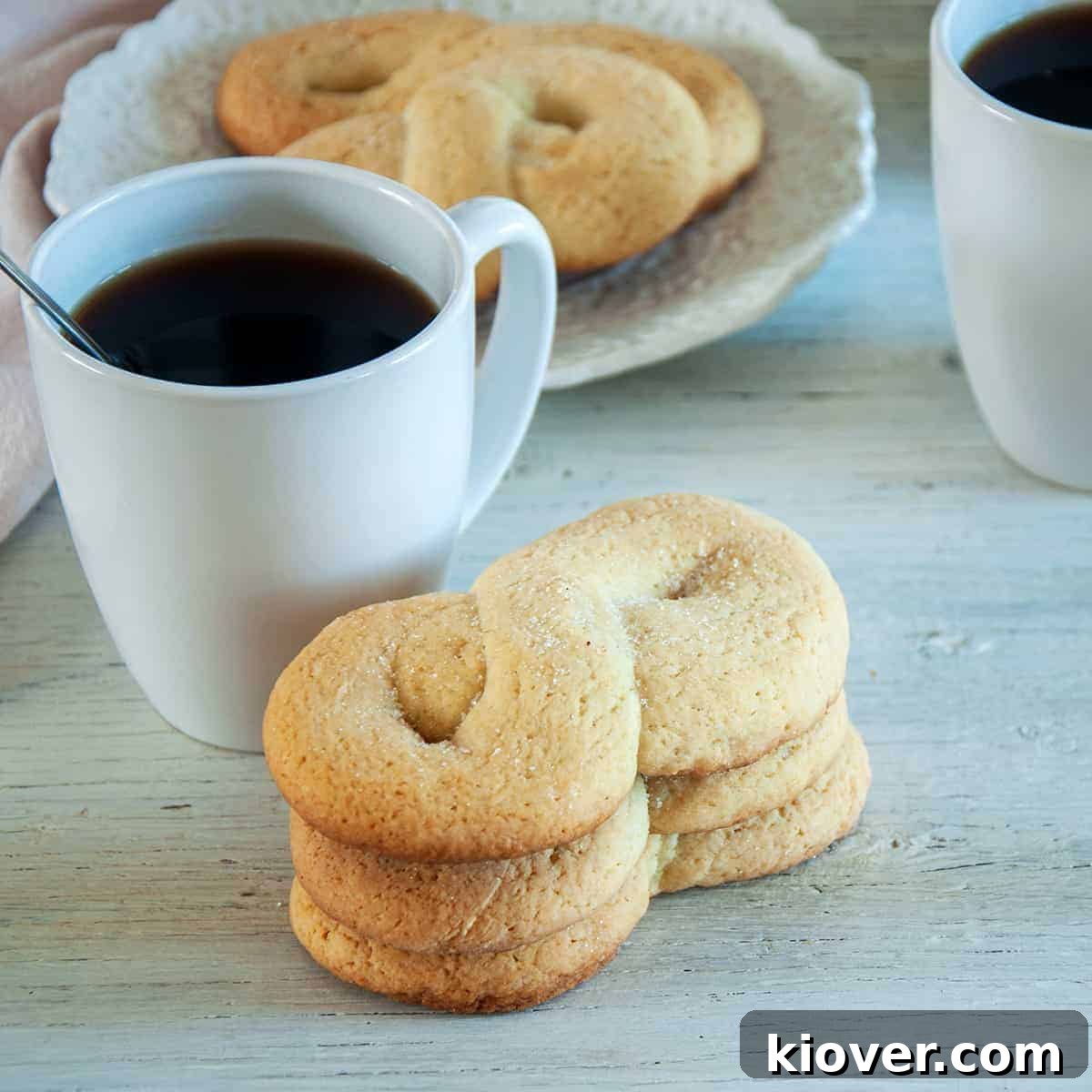
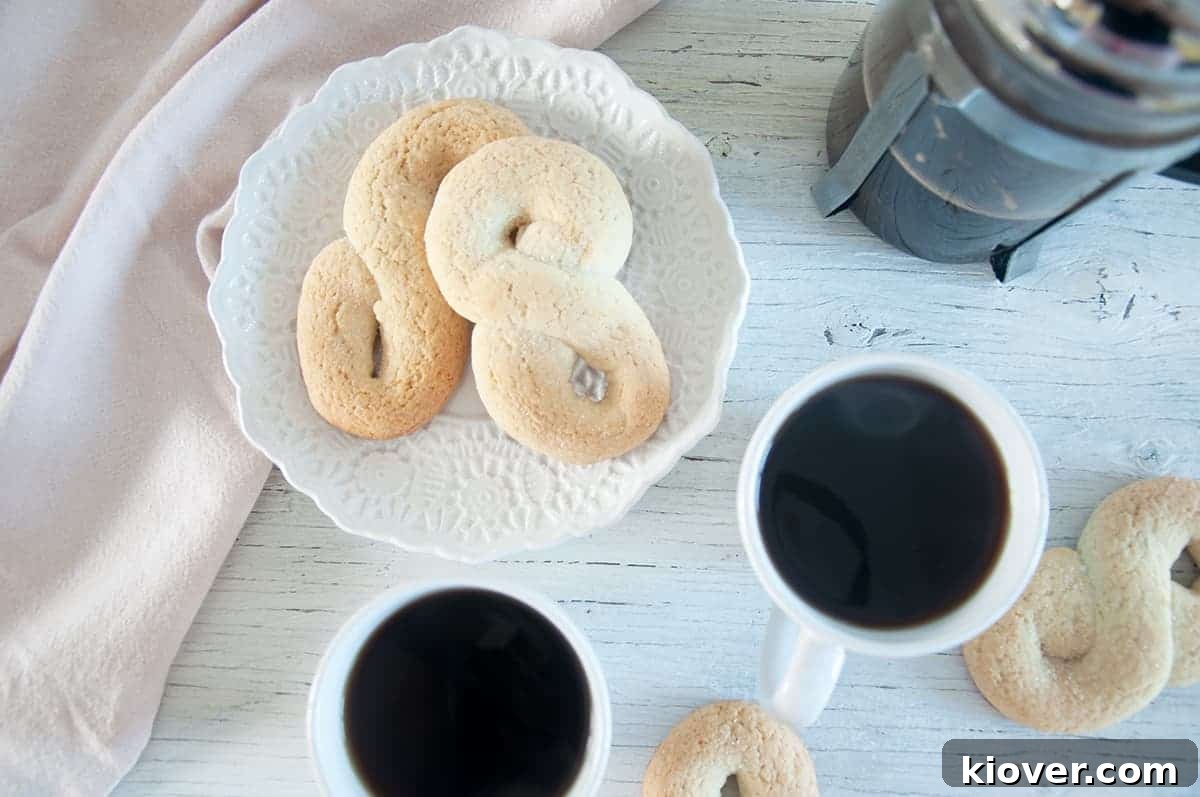
Embark on a delightful culinary journey this holiday season with our exquisite recipe for Kringler Cookies, a truly special and traditional Scandinavian treat. These charming cookies are celebrated for their wonderfully light, delicate, and subtly crumbly texture, making them an indispensable part of any Christmas cookie collection. Beautifully baked into the distinctive shape of an infinity sign, they offer not just a feast for the palate but also a visual delight. Perfectly paired with a steaming cup of coffee, or simply enjoyed on their own as a sweet holiday indulgence, Kringler cookies bring warmth and tradition to any gathering. We invite you to explore this beautiful and historic recipe, delve into its rich origins, and discover the joy of baking these delicious Scandinavian Kringler. Get ready to create cherished memories and fill your home with the irresistible aroma of holiday baking.
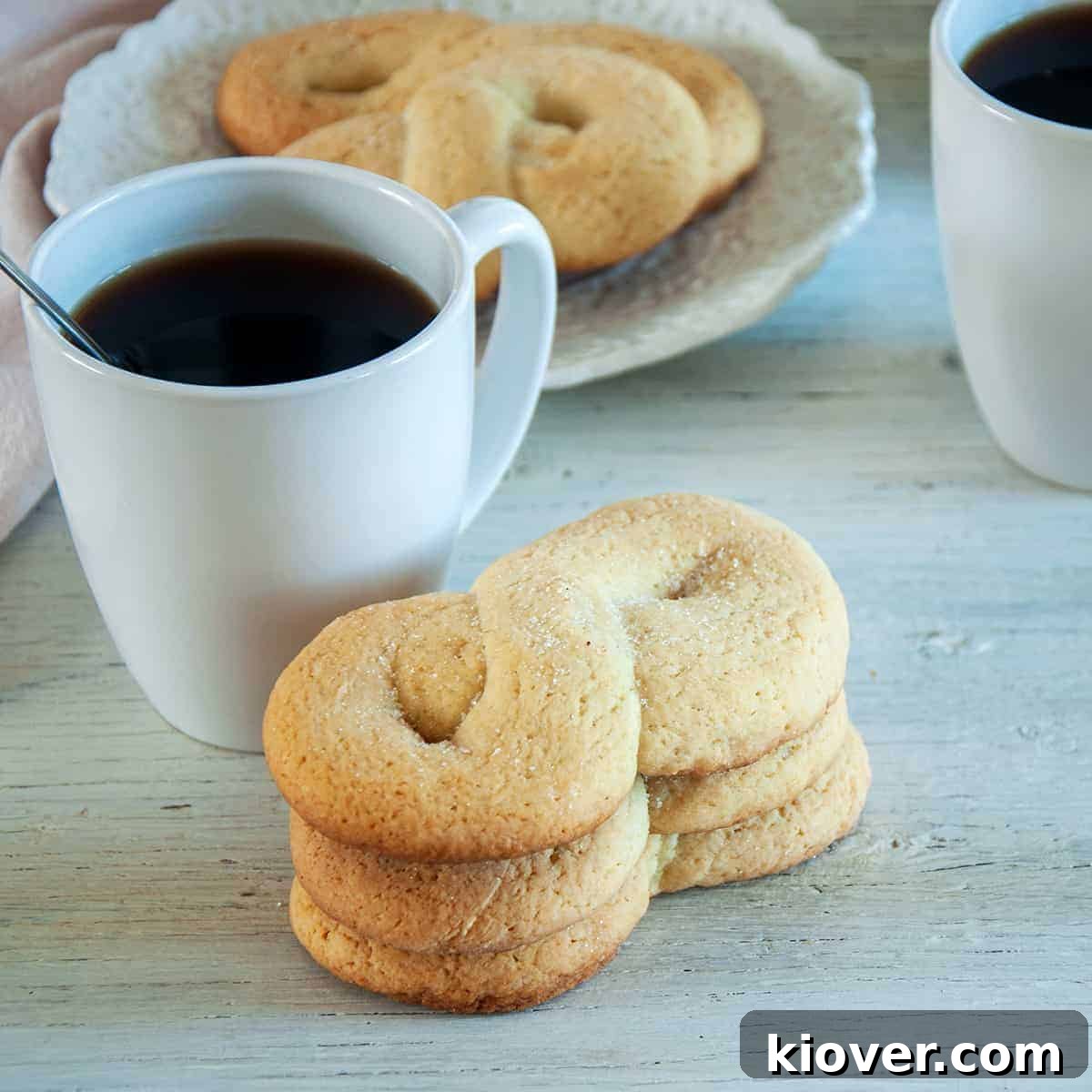
Unveiling the History of Kringler Cookies: A Sweet Evolution from Pretzels
The name “Kringler” itself carries a fascinating historical echo, directly translating to ‘Pretzel’ in Danish. This seemingly sweet cookie boasts a history deeply intertwined with its savory, twisted cousin. The journey of pretzels to Norway began centuries ago, introduced by Catholic monks who were renowned for their baking prowess, including bread-making. Over the years, as culinary traditions evolved and adapted, so too did the Kringler. What started as a more pretzel-like dough gradually transformed into the tender, sweet cookie we are delighted to share with you today. This particular variation of Kringler, while sharing an ancient lineage with its pretzel ancestors, has carved out its own unique identity as a beloved holiday confection.
While various regional interpretations exist under the names Kringle, Kringla, or Kringler, our recipe focuses on a specific, popular rendition enjoyed across America, especially during the festive season. This recipe stands out not only for its rich flavor and delightful texture but also for its remarkable simplicity. It’s an accessible project for bakers of all skill levels, coming together quickly and efficiently, often within an hour from start to finish. It incorporates many classic cookie ingredients but features a distinctive twist: the inclusion of sour cream. For truly unparalleled results, we wholeheartedly recommend using a homemade sour cream recipe, though a good quality store-bought alternative will also yield delicious cookies. The process is straightforward: simply combine the ingredients, master the art of shaping them into the iconic figure-eight or infinity symbol, and then bake them to a delicate golden perfection. A light dusting of sugar immediately after baking adds a final touch of sweetness and sparkle, followed by a brief rest on a wire rack, and they are ready to be savored.
Recipe Inspiration: A Journey into Culinary Heritage
The genesis of this particular Kringler cookie recipe is a charming story of culinary archaeology. It was unearthed from the pages of a vintage 1924 cookbook titled Cook Book of Popular Norse Recipes. Within its aged pages lay a recipe simply named “Flad Kringler,” which translates quite literally to “Flat Pretzel.” This discovery sparked a creative endeavor to modernize and elevate the traditional instructions and ingredient proportions to craft the incredibly tasty and aesthetically pleasing cookie it deserves to be today.
For those unfamiliar with really old cookbooks, they often present a delightful challenge. Their instructions tend to be exceptionally brief, sometimes even cryptic, demanding a certain level of intuition and baking experience to decipher. However, the true spirit and cultural essence embedded within these heritage recipes are endlessly fascinating to explore. There’s a profound joy in taking these historical blueprints and updating them to a modern standard, making them accessible to contemporary bakers while still honoring their deep-rooted heritage and cultural significance. Discovering and reinterpreting recipes like this Kringler truly fuels a passion for baking and cooking, connecting us to the past through delicious flavors. It’s a rewarding experience to bring these hidden gems back into the culinary spotlight, allowing new generations to appreciate the traditions they represent.
Beyond historical inspiration, the festive magic of Christmas is, of course, a primary muse for this recipe. Kringler cookies are not just a delicious treat; they embody the spirit of the holidays, perfect for sharing with loved ones or adding to a festive cookie platter. If you’re a devotee of classic Christmas cookies, we encourage you to explore our other cherished holiday recipes, such as the delicate Krumkake recipe, with its intricate patterns and sweet filling, and our wonderfully chewy Soft Ginger Cookie, bursting with real ginger flavor. These cookies, alongside our Kringler, promise to make your holiday baking truly memorable.
Exploring the Diverse World of Kringler: Beyond the Traditional Pretzel
The name Kringler, along with its singular forms Kringla or Kringle, encompasses a remarkably diverse array of Scandinavian baked goods, each with its own regional charm and characteristics. It’s important to understand that not all Kringler recipes are created equal, and this diversity is part of their rich cultural tapestry. For instance, if you travel to Wisconsin, you’ll encounter a highly popular version of Kringler that bears little resemblance to our cookie. This Wisconsin Kringle is typically a large, filled pastry, often circular in shape, with layers of rich dough and sweet fillings, resembling a kind of puff pastry cake or Danish.
More traditionally, and closer to its etymological roots, you’ll find Kringler variations that are indeed made from risen dough, much like a classic bread, and baked in a manner similar to pretzels. These might sometimes share the iconic infinity sign shape that our cookies adopt, or they might present in a more traditional pretzel knot. Given that the word “Kringler” literally means “pretzel,” it should come as no surprise that some variations are, in essence, actual pretzels, whether sweet or savory. These different forms highlight the adaptable nature of baking traditions and the regional interpretations that develop over time.
The fact that “not all Kringler recipes are the same” does not diminish the profound traditions, cultural heritage, and beloved flavors that each variation offers. Each Kringler, regardless of its form—be it a pastry, a bread, or a cookie—carries a piece of Scandinavian history and culinary art. The particular recipe we are exploring today is just one delightful version, and in our humble opinion, it’s an exceptionally tasty and wonderfully simple Kringler cookie that perfectly captures the essence of a sweet holiday treat.
The Secret Ingredient: Sour Cream’s Role in Kringler Perfection
One of the most notable and intriguing ingredients in this Kringler cookie recipe is the inclusion of sour cream. While readily available store-bought sour cream works perfectly well, we cannot stress enough the transformative power of using our homemade Sour Cream recipe. The depth of flavor, creaminess, and freshness that homemade sour cream brings to these cookies is truly unparalleled, elevating them from delicious to extraordinary. Be mindful that making sour cream from scratch does require a bit of foresight, as you typically need to start the process the night before to allow it ample time to culture and thicken. This extra step, however, is a small investment for the superior texture and subtle tang it imparts to the Kringler, contributing significantly to their light and tender crumb.
Effortless Mixing: Preparing Your Kringler Dough
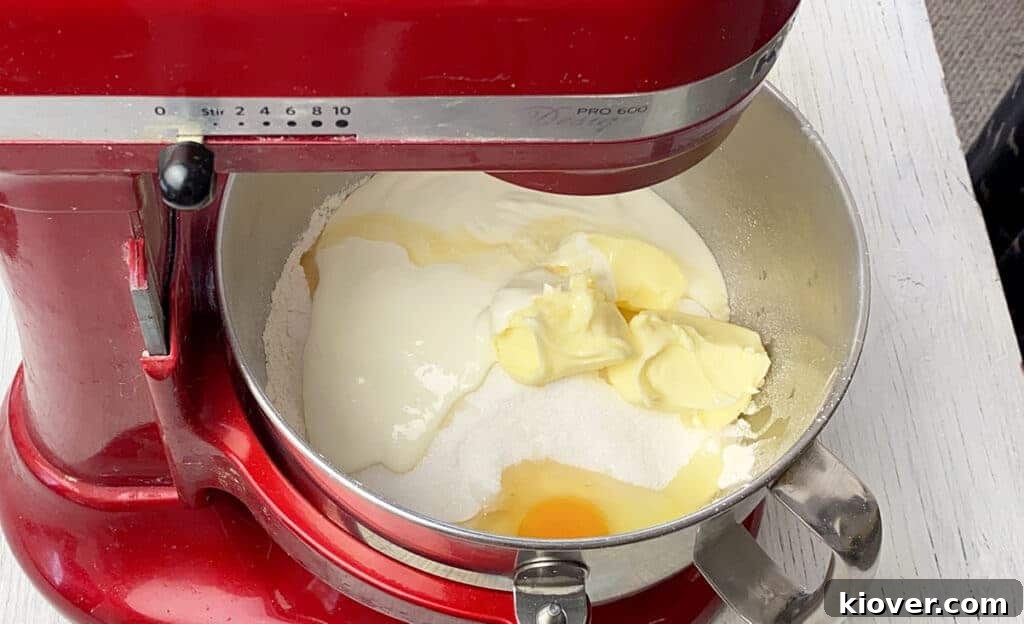
Preparing the dough for these Scandinavian Kringler cookies is remarkably straightforward, making them an ideal choice for any baker, whether novice or experienced. With the sole exception of a small amount of extra sugar reserved for sprinkling on top at the very end, the entire process simply involves combining all the ingredients. Let your stand mixer do the heavy lifting, effortlessly bringing together the flour, butter, sugar, sour cream, and flavorings into a cohesive and supple dough. Who can resist an easy and simple cookie recipe, especially when it promises such delicious results with minimal effort? This hassle-free mixing stage means you’re just a few steps away from enjoying freshly baked Kringler.
The Art of Shaping Kringler: Rolling and Twisting to Perfection
Once your dough is perfectly mixed and ready, the next step in creating these charming Kringler cookies is the enjoyable process of shaping. To ensure uniformity and an accurate count of 24 cookies, we highly recommend using a trusty kitchen scale. Weigh the entire batch of dough, then divide that total by 24 to determine the precise weight for each individual cookie. This simple step guarantees that all your Kringler will be roughly the same size, ensuring even baking and a beautiful presentation.
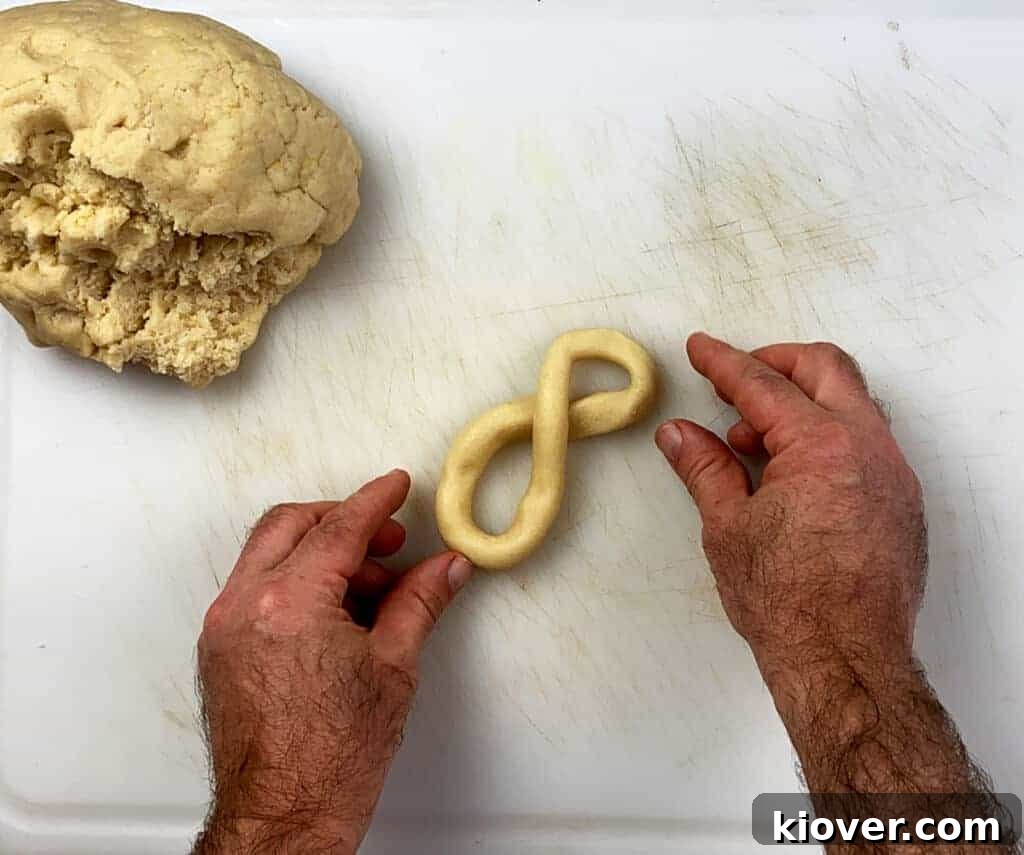
Take each portion of dough and gently form it into a small ball. Then, on a lightly floured surface or a clean cutting board, roll each ball out into a rope approximately 12 inches long. The key here is to aim for a uniform thickness throughout the entire rope. Once you have your perfectly rolled rope, connect the two ends to form a circle, gently pressing them together to seal. The next step is the signature Kringler twist: simply twist the middle of the circle, creating a figure-eight or infinity symbol. Position the twist so that it elegantly covers the seam where you connected the ends. If these instructions sound a bit abstract, don’t worry – consulting the provided video or process pictures can offer a clear visual guide to mastering this iconic shape. This careful shaping not only gives Kringler its traditional look but also contributes to its unique texture once baked.
Infinity Symbol or The Number Eight? Embracing the Kringler’s Iconic Shape
The distinctive shape of these Kringler cookies, often described as a figure-eight, holds a special charm. For us, it’s more than just a number; it evokes the beautiful concept of infinity. Why do we prefer to tie our cookies to infinity? Because cookies, for many, represent love, joy, and comfort – and love, indeed, is infinite. Alright, perhaps that’s a touch of poetic exaggeration, but it’s a sentiment we proudly stand by! That is, right up until the moment we joyously devour the “infinity” itself. Whether you choose to call it a figure-eight or an infinity symbol, this elegant twist is what gives the Kringler its timeless appeal and makes it such a recognizable and beloved holiday treat.
Optimizing Your Bake: Choosing and Using Cookie Sheets
For this Kringler cookie recipe, which yields a generous batch of 24 delicious cookies, the ideal baking vessel is a standard 9×13 cookie sheet (Affiliate Link). To ensure optimal baking and perfectly golden Kringler, we highly recommend utilizing the center rack of your oven. Since the recipe produces 24 cookies, and space on a single sheet is limited, you’ll either need to cycle your batches through the oven, allowing a bit of time between each, or ideally, employ multiple cookie sheets simultaneously. In our kitchen, two 9×13 cookie sheets prove to be just right, allowing us to bake the entire batch efficiently. The first set goes in, and while they’re baking, the second set is shaped and ready to follow. The final few cookies might even join the first batch on the same sheet. While the dream of unlimited kitchen equipment is appealing, two sheets are perfectly sufficient for achieving great results. If you are fortunate enough to possess three cookie sheets, by all means, use them to streamline your baking process even further! Lining your cookie sheets with parchment paper is also a highly recommended step to prevent sticking and ensure easy cleanup.
The Perfect Bake: Achieving a Very Light Golden Brown Hue
Precision is key when baking these delicate Kringler cookies to achieve their characteristic light and tender texture. We’ve found that setting the oven to 400°F (200°C) and baking them on the center rack for approximately 12 minutes yields the best results. However, every oven can vary, so it’s crucial to keep a close eye on your cookies. The goal is to achieve a very subtle change in color – a mere kiss of light golden brown on top and around the edges. Avoid overbaking, as this can result in a dry or overly crispy cookie, detracting from the Kringler’s intended delicate crumb. They should appear light-colored, with just a hint of golden warmth. Begin checking at the 10-minute mark and continue baking until that desired very light golden hue begins to emerge on the surface, indicating they are perfectly cooked through.
The Finishing Touch: A Delicate Sprinkle of Sugar
Once your beautiful Kringler cookies emerge from the oven, still warm and inviting, it’s time for their final flourish: a delicate dusting of sugar. This step is more than just decorative; it adds a crucial layer of sweetness and a delightful textural contrast. The cookies, hot and slightly moist from baking, are perfectly primed for the sugar to adhere. The granules will melt ever so slightly, creating a glistening, slightly crisp coating that enhances every bite. A light and even sprinkle is all that’s needed to transform them, adding that perfect touch of sparkle and an extra dimension of sweetness to these already delicious treats. We recommend using granulated sugar, but a finer caster sugar can also provide a delicate finish.
Patience is a Virtue: Allowing Your Kringler Cookies to Cool Properly
As tempting as it may be to immediately sample your freshly baked Kringler cookies, exercising a little patience during the cooling process is absolutely essential. When first removed from the oven, these delicate cookies will be quite soft and fragile, making them too delicate to handle. Allow them to rest on the hot cookie sheet for a few minutes – typically about 5 to 7 minutes – until they firm up slightly. This brief period on the warm sheet helps them set without breaking. Once they are sturdy enough to gently lift with a spatula, carefully transfer them to a wire rack. This allows air to circulate around all sides of the cookies, ensuring they cool completely and uniformly. Give them at least thirty minutes of cooling time on the rack before attempting to move them further or, more challenging still, resisting the urge to take a bite. Proper cooling is vital for achieving their perfect texture and allows their flavors to fully develop.
A Deeper Dive: The Rich History and Cultural Journey of Kringler
As we’ve touched upon, the Kringler cookie has a captivating history intrinsically linked to pretzels, a connection solidified by its Danish name, which literally translates to “pretzel.” However, a glance at our sweet, infinity-shaped cookie quickly reveals it’s far removed from the savory pretzels one typically finds in a store today. The story of Kringler’s origins traces back centuries to Roman Catholic Monks who ventured into Norway. These monks were not only spiritual leaders but also highly skilled artisans, often bringing with them valuable practical knowledge in trades like winemaking and, significantly for our story, bread baking. Given that a traditional pretzel is fundamentally a type of bread, its creation was well within the established culinary expertise of these monastic communities.
How our specific version of Kringler, the sweet cookie, came to be so distinct from its pretzel ancestors is a journey shrouded in the delightful mists of culinary evolution. Yet, it still retains a few fundamental commonalities with its traditional pretzel heritage. Firstly, both are flour-based items, forming the foundational dough. Secondly, and perhaps most strikingly, both are defined by their distinctive shapes. While the traditional pretzel boasts its classic knot, our Kringler proudly wears the elegant form of the infinity sign. The exact reasons behind this stylistic divergence remain a charming mystery, perhaps born from an artistic baker’s whim or a specific regional tradition, but it has certainly become a common and beloved hallmark of this particular Kringler variation.
Today, especially in America, the term “Kringler” has become an umbrella for a variety of delights, each reflecting the diverse culinary paths taken by Scandinavian immigrants. You might still encounter versions that closely resemble the traditional pretzel, often made with a yeast-risen dough, savory or mildly sweet. Then there are the more elaborate pastry-like versions, often filled with fruit or nuts, akin to a Danish. And finally, there’s the version we celebrate today – the cookie, a small, sweet, and tender treat. This broad spectrum of Kringler recipes is a testament to the extensive emigration of Norwegians and other Scandinavians across the globe and particularly to the United States. Over generations, in new lands with new ingredients and influences, there was ample time and space for these cherished recipes to adapt, evolve, and diversify, creating the rich mosaic of Kringler variations we enjoy today, each a delicious echo of a shared heritage.
The Specific Ancestry of Our Kringler Recipe
To fully appreciate the lineage of this Kringler cookie recipe, we are providing both the link and an image of the original recipe that served as our inspiration. This heritage recipe was discovered in a 1924 publication titled “Cook Book of Popular Norse Recipes,” a true treasure trove of traditional Scandinavian fare. This particular entry, “Flad Kringler,” offered a glimpse into early 20th-century baking methods.
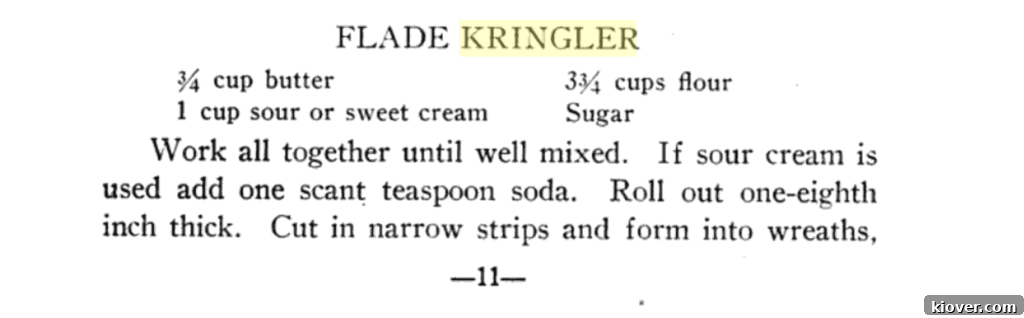
As you can clearly observe from the image, the instructions in this vintage cookbook are notably brief and concise. This lack of detailed guidance was quite commonplace in cookbooks of that era; it was often assumed that the home baker possessed a foundational understanding of basic techniques. The recipe presented a skeletal framework, requiring an interpretive hand to flesh out the steps and ensure a successful outcome for modern cooks. It highlights the evolution of recipe writing, from terse commands to the comprehensive, step-by-step guides we expect today.
Interestingly, even within the confines of this single 1924 cookbook, the diversity of Kringler recipes is evident. Beyond “Flad Kringler,” the book includes at least two other distinct recipes for Kringler, both of which involve a yeast rise. This internal variety within a single historical text underscores the long-standing tradition of Kringler adaptations and regional differences, proving that even a century ago, the Kringler was a versatile and evolving culinary concept.
Expert Tips for Crafting Perfect Kringler Cookies
- **Bake One Pan at a Time:** For optimal results and even cooking, always bake your Kringler cookies one pan at a time. Placing the pan on the center rack of your oven ensures consistent heat distribution and prevents uneven browning, guaranteeing each cookie achieves that perfect light golden hue.
- **Cookie Sheet Management:** If your kitchen boasts only one or two 9×13 cookie sheets, don’t fret! Simply utilize your first pan for two separate batches. After the initial batch has baked and cooled enough to be transferred to a wire rack, reuse the same sheet for the remaining cookies. This method ensures all your Kringler are perfectly baked, even with limited equipment.
- **Sugar Sprinkle Timing is Key:** The moment your Kringler cookies emerge from the hot oven, swiftly give them a light and even sprinkle of granulated sugar. The residual heat and moisture on the cookies’ surface allow the sugar to adhere beautifully, creating a delightful sugary crust that enhances both flavor and texture.
- **The Perfect Companion:** These sweet, tender Kringler cookies are an absolute match made in heaven when paired with a fresh cup of coffee. The slightly rich, comforting notes of the coffee beautifully complement the subtle sweetness and delicate flavors of the cookies, making for an ideal morning treat or an afternoon indulgence.
Recommended Kitchen Tools for This Recipe
- 9×13 cookie sheet: Essential for baking evenly sized batches.
- KitchenAid Mixer: Makes mixing the dough quick and effortless.
- Wire Rack: Crucial for cooling cookies evenly and preventing sogginess.
Share Your Kringler Experience!
We are absolutely thrilled that you decided to give our cherished Kringler cookie recipe a try! Your baking adventures inspire us, and we’re eager to hear all about how it went for you. Please take a moment to share your experience in the comments section below and consider leaving a rating. Your feedback is incredibly valuable, not only for us but also for other aspiring bakers who visit our site. It helps us understand what worked well and provides helpful insights for our community. If these sweet Scandinavian delights truly captured your heart and taste buds, don’t keep them a secret! We’d be incredibly grateful if you’d share this recipe with your friends and family on Facebook or Pinterest, spreading the joy of homemade holiday treats. Most importantly, thank you for visiting Ramshackle Pantry. We hope you enjoyed your time with us and will stop back soon to discover more delicious recipes!

Kringler Cookies Recipe
5 Stars 4 Stars 3 Stars 2 Stars 1 Star
5 from 1 review
Author: Ben Myhre
Prep Time: 15 minutes
Cook Time: 40 minutes
Total Time: 55 minutes
Yield: 24 cookies
Category: Dessert
Method: Bake
Cuisine: Scandinavian
Description
These sweet Scandinavian Kringler cookies are a true delight—tasty, tender, and a beautiful addition to any Christmas celebration. They are surprisingly easy to make and serve as the perfect accompaniment to a cup of coffee, or enjoyed simply on their own. Discover the joy of this traditional holiday treat today!
Ingredients
- 4 Cups All-Purpose Flour
- 3/4 cup butter, softened
- 1 1/2 cups sugar + extra sugar to top once out of the oven
- 1 1/2 teaspoon baking soda
- 1 cup sour cream (optionally, homemade)
- 1/2 teaspoon vanilla extract
- 1 teaspoon almond extract
- 1/2 teaspoon salt
- 1 egg
Instructions
- Preheat your oven to 400°F (200°C) to ensure it’s ready for baking.
- In a large mixing bowl, combine all the ingredients as listed, reserving only the extra sugar designated for topping the cookies after they bake.
- Beat the mixture in a stand mixer for about one minute until well combined, or if kneading by hand, work the dough for approximately three minutes until it’s smooth and pliable.
- Once your dough is ready, divide it into 24 equal parts. A kitchen scale can help ensure precise portions. Then, gently roll each part into a small ball.
- On a lightly floured surface, take each dough ball and roll it out into a uniform rope, approximately 12 inches in length and of even thickness.
- Carefully form the rope into a circle, pressing the ends together to seal. Then, twist the circle in the middle to create the distinctive figure-eight or infinity sign shape. Ensure the twist covers the seam.
- Place the shaped cookies onto a lightly oiled (or parchment-lined) cookie sheet, leaving enough space between each cookie to prevent them from touching as they bake.
- Repeat the shaping process for all cookies. This recipe yields 24 cookies, so you will likely need at least three cookie sheets, or plan to bake in batches.
- Bake the cookies on the center rack of your preheated oven for 12 minutes, or until they achieve a very light golden brown color on top. Avoid overbaking to maintain their tender texture.
- Immediately upon removing the cookies from the oven, lightly sprinkle them with the reserved sugar. The heat and moisture will help the sugar adhere beautifully.
- Allow the cookies to cool on the baking sheet for a few minutes until they are firm enough to handle. Then, carefully transfer them to a wire rack to cool completely for at least 30 minutes.
- Serve your delicious Kringler cookies and enjoy!
Notes
- Cook each pan one at a time on the center rack for the most even and consistent baking results.
- If you don’t have three 9×13 cookie sheets, simply use the first pan twice. Once the first batch has cooled and been removed, prepare the second batch on the same sheet.
- Remember to save some sugar specifically for sprinkling on top of the cookies immediately after they come out of the oven to create that delightful finish.
- These delicate Kringler cookies are absolutely marvelous when enjoyed with a warm cup of coffee, making them a perfect pairing for breakfast or an afternoon fika.
Nutrition
- Serving Size: 1 Cookie
- Calories: 126 Calories
- Sugar: 14 g
- Sodium: 117 mg
- Fat: 8 g
- Saturated Fat: 5 g
- Unsaturated Fat: 3 g
- Carbohydrates: 14 g
- Fiber: 0 g
- Protein: 1 g
- Cholesterol: 23 mg