
The Moscow Mule, a refreshingly zesty cocktail served in its distinctive copper mug, has become a global phenomenon. Its vibrant flavor profile—a harmonious blend of vodka, ginger beer, and fresh lime juice—makes it a perennial favorite, especially during warmer months. But beyond its undeniable appeal, the story behind this iconic drink is far more intriguing than many realize. Often mistakenly believed to hail from Russia, the Moscow Mule’s origins are deeply rooted in American ingenuity and a brilliant marketing strategy that forever changed the landscape of the spirits industry in the United States.
Before the Moscow Mule burst onto the scene in the early 1940s, vodka was a relatively obscure spirit in America. Whiskey, gin, and bourbon dominated the bar carts and lounges of the era, making it a challenging market for any new liquor to penetrate. Yet, thanks in large part to the strategic creation and promotion of the Moscow Mule, vodka transitioned from a tough sell to one of the most popular spirits by volume in the U.S. This remarkable shift highlights the profound impact a single cocktail can have on an entire industry. Join us as we delve into the surprising, entrepreneurial tale of the Moscow Mule, a cocktail that embodies American marketing prowess and a lasting legacy.
The Unexpected Birthplace: Los Angeles, Not Moscow
Perhaps the most startling revelation about the Moscow Mule is its true genesis: it wasn’t born in the frosty landscapes of Russia, but under the sunny skies of Los Angeles, California. This geographical disconnect immediately dispels a common misconception, setting the stage for a story driven by ambition rather than ancient tradition. Furthermore, despite its name, there isn’t a literal ‘mule’ involved in the drink’s composition, although its signature spicy kick from the ginger beer certainly evokes the powerful jolt of a mule’s hind leg. The history of the Moscow Mule is, in essence, a meticulously crafted narrative born from the minds of two individuals determined to overcome significant market challenges through a cleverly conceived marketing strategy.
Many classic cocktails boast hazy, often conflicting origin stories, frequently fueled by attempts to claim glory or boost sales. While the Moscow Mule’s narrative also features multiple accounts, they all converge around the same pivotal characters: John Martin, then owner of Smirnoff Vodka, and John Morgan, who had created a brand of ginger beer called Cock ‘n Bull. These two men, facing distinct but equally daunting business hurdles, would serendipitously combine their efforts to create a drink that would solve both their problems and carve out a permanent place in cocktail lore.
Historical accounts, including various wiki pages and online searches, often present slightly different versions of the Moscow Mule’s creation. However, rigorous research, particularly referencing direct accounts from John Martin himself, solidifies the core narrative. Martin’s firsthand testimony offers invaluable insight, providing a foundation of truth that minimizes skepticism. His detailed recollections, free from apparent self-aggrandizement, paint a clear picture of the drink’s inception and the strategic thinking behind it. This direct source offers a rare and compelling glimpse into the true history of this beloved cocktail.
For those interested in hearing the story directly from one of its architects, a video featuring John Martin discussing the Moscow Mule’s history offers a fascinating perspective. While the full interview covers broader topics, the segment discussing the Moscow Mule provides rich context and authenticity to the narrative we explore here. It’s a testament to the power of original sources in uncovering historical truths.
John Martin and the Smirnoff Vodka Predicament
In 1939, John Martin made a significant investment, purchasing Smirnoff Vodka. At the time, Smirnoff was a relatively unknown and struggling brand in the American market. The United States was a nation deeply entrenched in its love affair with whiskey, and other spirits, particularly one as seemingly bland and unfamiliar as vodka, struggled to gain a foothold. American drinkers were accustomed to the robust flavors of bourbon and rye, and the colorless, odorless characteristics of vodka made it a challenging product to market. Martin, a shrewd businessman, understood that he needed a revolutionary approach to introduce vodka to the American palate and carve out a niche for Smirnoff.
His challenge was not merely to sell a product, but to alter deeply ingrained drinking habits and perceptions. Vodka, often seen as an exotic Russian import, didn’t fit neatly into the established American drinking culture. Martin tirelessly sought innovative ways to position Smirnoff, exploring avenues that would make vodka approachable, versatile, and ultimately, desirable to the average American consumer. His quest for market penetration would soon lead him to a fortuitous encounter that would forever change the fortunes of Smirnoff and the trajectory of American cocktail culture.
John Morgan and the Cock ‘n Bull Ginger Beer Struggle
The other pivotal figure in the Moscow Mule’s genesis was John Morgan, an entrepreneur with his own set of marketing challenges. Morgan was the proprietor of a popular establishment on the famed Sunset Strip in Los Angeles, a bar also named Cock ‘n Bull. This bar was a vibrant hotspot, frequented by celebrities and cultural icons throughout its storied existence, drawing luminaries such as Jim Morrison, Richard Burton, and Rod Stewart, until its eventual closing in the late 1980s. While his bar enjoyed considerable success, Morgan’s venture into the beverage market with his Cock ‘n Bull Ginger Beer was proving to be a much harder sell.
Americans of the era simply hadn’t embraced ginger beer with the same enthusiasm they showed for its sweeter, non-alcoholic cousin, ginger ale. The distinction between the two beverages is crucial to understanding Morgan’s dilemma. Ginger ale, essentially a ginger-flavored soda or “pop,” is generally lighter in taste, often less carbonated, and features a milder ginger flavor. Ginger beer, on the other hand, is traditionally a fermented concoction made from ginger, sugar, and water. This fermentation process gives it a much bolder, spicier ginger flavor and a more pronounced “kick,” sometimes with a very low alcohol content (though generally considered non-alcoholic for commercial sale). For American palates accustomed to the gentle effervescence of ginger ale, ginger beer was perceived as too strong, too exotic, or simply too different. Morgan, much like Martin, was struggling to introduce a product that didn’t yet have a natural home in the American market.
The Cock ‘n Bull Bar itself holds a fascinating place in Los Angeles history, serving as a cultural landmark and a backdrop for countless Hollywood tales. Its significance as a meeting point for artists, musicians, and industry figures adds another layer of charm to the Moscow Mule’s story, underscoring the era’s dynamic entrepreneurial spirit that brought such disparate elements together. Its own unique history is well worth exploring, providing further context to the vibrant world in which the Moscow Mule was conceived.
The Fateful Meeting: Where Two Worlds Converged
The stage was set for a truly serendipitous encounter. Facing parallel struggles in bringing their respective products to the American mainstream, John Martin and John Morgan converged at the Cock ‘n Bull Bar in 1940. This was no chance meeting; it was a deliberate gathering, driven by a shared desire to overcome their market hurdles. They both recognized the need to create something entirely new—a distinctive drink that could simultaneously elevate the profile of Smirnoff Vodka and make Cock ‘n Bull Ginger Beer an indispensable ingredient. That pivotal evening, these two visionaries, along with Morgan’s girlfriend, Ozaline Schmidt, sat down, mixed ingredients, and, in a stroke of genius, invented the Moscow Mule.
The creative process was simple yet revolutionary. Martin had an abundance of Smirnoff vodka and Morgan had his struggling ginger beer. They added fresh lime juice, a common cocktail ingredient that would brighten the flavors and tie the two distinct elements together. Martin himself later admitted he wasn’t entirely certain about the precise origin of the ‘Mule’ in the drink’s name, but he was quite confident that it was inspired by the spicy, invigorating “kick” delivered by the ginger beer—a sensation that resonated perfectly with the powerful, distinctive character of a mule. This combination was not just a drink; it was a carefully considered solution to two pressing business problems, a testament to the power of collaborative innovation.
The Iconic Copper Mug: An Integral Part of the Moscow Mule Mystique
One of the most instantly recognizable features of the Moscow Mule is its distinctive serving vessel: the polished copper mug. This unique glassware isn’t merely an aesthetic choice; it has become an inseparable part of the drink’s identity, influencing its perception and popularity. The origin of the copper mug’s inclusion is as intertwined with the cocktail’s creation as the ingredients themselves, adding another layer to its fascinating history, and once again featuring Ozaline Schmidt.
According to legend, Ozaline Schmidt, John Morgan’s girlfriend and a key participant in the drink’s creation, had recently inherited a family copper mine. Despite her new ownership, she faced difficulties in selling the copper. As the trio experimented with the new cocktail, the idea of serving it in copper mugs emerged, a brilliant stroke of synergistic branding. Not only would this help Schmidt liquidate her copper stock, but it also provided a unique, eye-catching presentation that would differentiate the Moscow Mule from every other drink on the market.
Beyond its marketing utility, the copper mug offers practical benefits. Copper is an excellent thermal conductor, meaning it quickly adopts the temperature of the icy drink and keeps it refreshingly cold for longer. The cold copper also creates a satisfying frost on the outside of the mug, enhancing the sensory experience and making the drink even more appealing. There’s also an intriguing, albeit unconfirmed, anecdote suggesting that at one point, copper mugs were the standard serving ware for all drinks served in a mug at the Cock ‘n Bull bar, not just the Moscow Mule. While its universal use at the bar remains debated, the fact that someone with a vested interest in copper was present during the drink’s inception strongly links the mug to the cocktail’s foundational story. The copper mug thus became more than just a container; it became an emblem, a symbol of the Moscow Mule itself, deeply rooted in the pragmatic and ingenious spirit of its creators.
The Post-War Marketing Blitz: Vodka’s Golden Age
Despite its invention in 1940, the Moscow Mule’s widespread marketing efforts were temporarily shelved due to the outbreak of World War II. Smirnoff Vodka production was understandably impacted by the war, diverting resources and attention away from consumer marketing campaigns. However, once the war concluded in 1945, John Martin reignited his ambitious plans, launching an aggressive promotional campaign for both Smirnoff Vodka and its flagship cocktail, the Moscow Mule. This post-war period marked the true beginning of vodka’s ascent in America.
Martin’s marketing strategy was revolutionary for its time, demonstrating a keen understanding of grassroots promotion and psychological influence. He encountered significant resistance from bartenders, who were hesitant to embrace an unfamiliar spirit and a new drink. To overcome this, Martin devised an ingenious tactic: he traveled from bar to bar armed with one of the era’s cutting-edge gadgets—a Polaroid camera. He would entice bartenders to mix a Moscow Mule, then immediately snap a photo of them proudly holding their creation. In exchange for their participation, the bartenders received an instant, processed photo to take home—a novel and exciting personal keepsake in an age before ubiquitous digital photography.
This clever approach had a dual impact. Bartenders, delighted by the innovative gadget and their personal memento, were more inclined to learn and serve the drink. Crucially, Martin would then take a second photograph of the bartender with the Moscow Mule and bring it to a competing bar down the street. Showing a rival establishment already serving the trendy new drink created a sense of urgency and competition, prompting other bartenders to adopt it to avoid being left behind. This “Polaroid push” was a brilliant example of early guerrilla marketing, effectively overcoming resistance and rapidly spreading the Moscow Mule across the nation, paving the way for vodka’s widespread acceptance. It was a strategy that leveraged novelty, social influence, and a tangible reward, demonstrating Martin’s deep understanding of human nature and market dynamics.
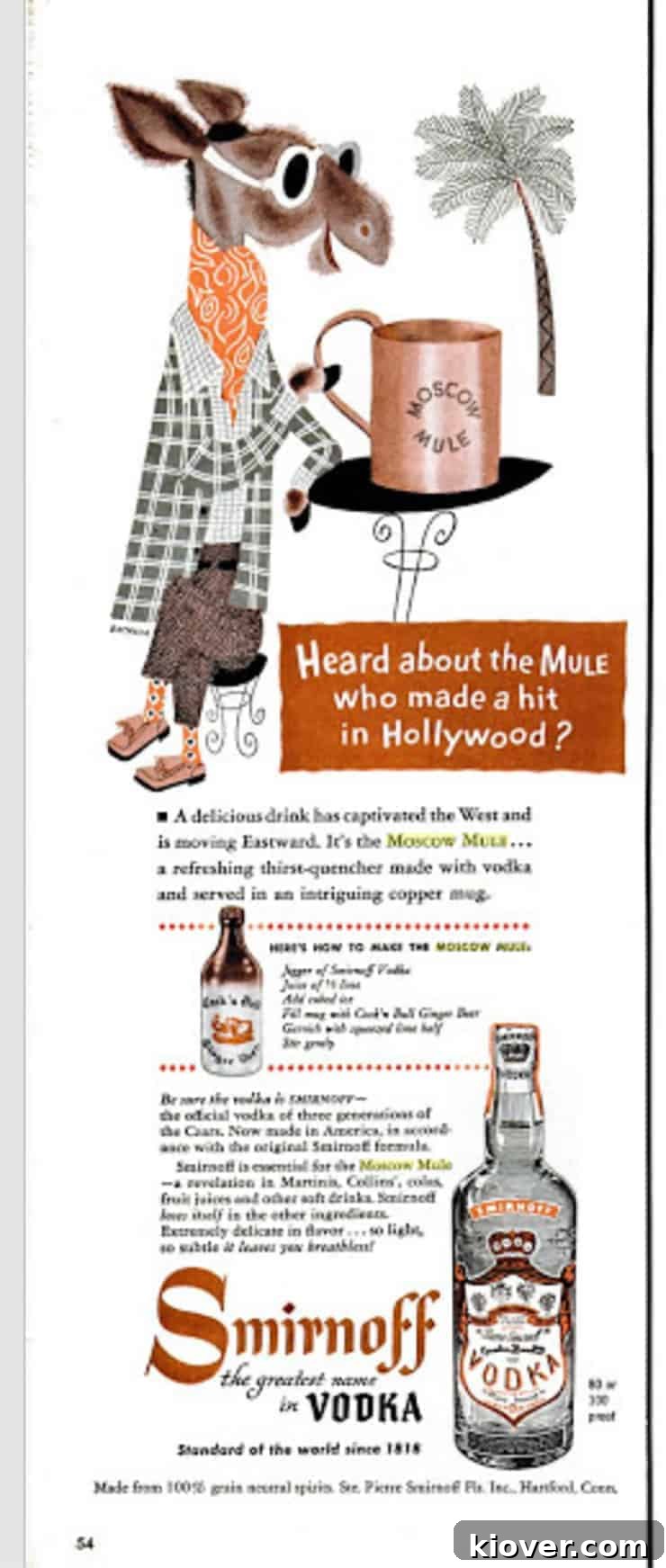
The success of this campaign quickly led to the Moscow Mule being featured in major publications. A Smirnoff advertisement in a 1950 issue of Life Magazine, for instance, prominently displayed the recipe, further solidifying the drink’s status. What’s particularly noteworthy about this ad is its subtle positioning of vodka as a “flavorless alcohol” suitable for traditional drinks. This message was critical in helping Americans understand how to integrate this new spirit into their existing cocktail repertoire, moving beyond the Moscow Mule itself. The ad cleverly demonstrated vodka’s versatility, laying the groundwork for its eventual dominance as a neutral base spirit, capable of enhancing, rather than overpowering, other flavors. This era truly marked the golden days of the Moscow Mule, catapulting Smirnoff, and vodka as a category, into the American mainstream.
The Decline and Brief Disappearance
While vodka’s popularity continued its upward trajectory throughout the mid-20th century, the Moscow Mule itself experienced a gradual decline in favor during the 1960s and 1970s. The precise reasons for this dip in its widespread appeal are complex and multifaceted, reflecting shifting cocktail trends and evolving consumer tastes. One significant factor was likely Smirnoff’s strategic pivot. Once vodka had firmly established its presence in the American market, the brand’s marketing focus naturally broadened to promote other vodka-based cocktails. The rise of the Vodka Martini, heavily popularized by the James Bond films of the era, offered a more sophisticated, elegant image that resonated with changing desires, diminishing the unique urgency to promote the Moscow Mule specifically.
The cocktail landscape itself was undergoing transformations. The 60s and 70s saw the emergence of sweeter, often more colorful “disco drinks,” moving away from the simpler, spicier profile of the Moscow Mule. As tastes evolved, many classic cocktails that didn’t adapt or weren’t actively promoted by major brands faded from widespread public consciousness. Furthermore, the original Cock ‘n Bull Ginger Beer brand, while instrumental in the Mule’s creation, faced its own challenges in maintaining market visibility. While a brand named Cock ‘n Bull Ginger Beer exists today and claims connection to the original Moscow Mule history, concrete details linking the current iteration directly to the 1940s company are scarce, making it difficult to trace the brand’s continuous lineage. The absence of a strong, consistent ginger beer brand alongside Smirnoff’s shifting priorities likely contributed to the Moscow Mule receding into the background of cocktail history.
For a generation of bartenders, including myself who tended bar up until the early 2000s, the Moscow Mule was an unknown entity. During my years behind the bar, even in college towns where new trends often surfaced, I was never once asked for a Moscow Mule, nor did I personally know what it was. This anecdotal evidence underscores just how much the drink had fallen out of favor, becoming a niche curiosity rather than a mainstream staple. It lay dormant, a forgotten gem waiting for a new era to rediscover its refreshing charm.
The Resurgence: A Modern Comeback
Fortunately for cocktail enthusiasts, the Moscow Mule was destined for a triumphant return. The timeline of its remarkable resurgence can be quite accurately pinpointed thanks to modern tools like Google Trends. Data indicates that around 2014, searches and interest in the Moscow Mule began to spike dramatically, signaling its re-entry into the popular lexicon of cocktails. This wasn’t just a brief flicker; it marked the beginning of a sustained revival that has firmly re-established the drink as a contemporary classic.
Several factors likely contributed to this impressive comeback. First and foremost, the drink simply tastes good. Its refreshing combination of spicy ginger, tart lime, and clean vodka offers a balanced and universally appealing flavor profile. In an era where consumers are increasingly seeking out well-crafted, balanced beverages, the Moscow Mule’s inherent qualities shine through. Secondly, the mid-2010s witnessed a flourishing craft cocktail movement, a period characterized by a renewed appreciation for classic and forgotten drinks. Bartenders and enthusiasts alike began delving into cocktail history, rediscovering recipes that had been overlooked for decades. The Moscow Mule, with its compelling backstory and simple elegance, fit perfectly into this trend of reconnecting with “cool stuff from long ago.”
Moreover, the distinctive copper mug played a significant role in its modern popularity, particularly in the age of visual social media platforms like Instagram. The gleaming copper, often adorned with a lime wedge and a sprig of mint, makes for an incredibly photogenic drink, encouraging sharing and creating a viral effect. This visual appeal, combined with the drink’s refreshing taste and a nostalgic nod to classic Americana, propelled the Moscow Mule back into the spotlight. It became a symbol of discerning taste and a casual elegance, easily ordered and consistently enjoyed, cementing its place once again as a beloved cocktail icon.
Conclusion: A Marketing Masterpiece with Enduring Appeal
The Moscow Mule stands as a truly integral, and perhaps surprising, chapter in the story of vodka’s journey to prominence in the United States. Far from being an ancient Russian concoction, its history is a testament to savvy marketing and entrepreneurial spirit, born from the collective efforts of two determined businessmen and an unexpected copper connection. It was, at its heart, a brilliant marketing push designed to overcome challenging market conditions for both Smirnoff Vodka and Cock ‘n Bull Ginger Beer.
The success of this endeavor was nothing short of phenomenal, particularly for the Smirnoff brand, which rode the Moscow Mule’s popularity to become a household name. What began as a strategic solution to business problems evolved into a cultural phenomenon. Despite its period of decline, the Moscow Mule’s intrinsic qualities—its crisp flavor, refreshing kick, and distinctive presentation—ensured its eventual rediscovery and resurgence. Today, it remains a beloved cocktail, celebrated for its taste, its iconic copper mug, and its fascinating, made-in-America tale. It has earned its rightful place as a cornerstone of modern cocktail culture, a testament to its enduring appeal and the ingenious vision of its creators.